Huntron Custom Prober Systems
Productivity Challenges of Manually Probing High Density Circuits
Vision, Dexterity and Distractions continually limit the effectiveness and reliability of diagnostic measurements.
Technicians and engineers equipped with the most advanced test instruments still have to locate the test point, place the probe and take the measurement.
Start by identifying the processthat needs to be automated and then consider the requirements that will fix your problem.
Define the accuracy, speed and number of test points you require then look at the robotic platform options available.
Lastly, consider the price versus the cost savings in reduced test time, fewer misplaced probes and lower burden on engineering resources.
-
Vision Factor:
High density circuit components are difficult to see and often require magnification devices.
-
Dexterity Factor:
Measurement points can be small and close together. Accurate probe placement and repeatable measurements can be difficult.
-
Distraction Factor:
Interruptions by telephones, coworkers, pages and meetings can take their toll on completing a test procedure.
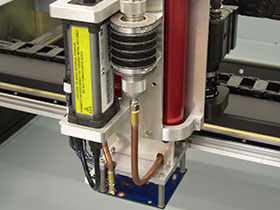
Access 2 Prober with Remote Control
-
Minimal time needed from Concept to Installation
-
Huntron Workstation runs in the background
-
Users can set up their own Test Executive control
-
Easy to set up, configure and control
-
Learn More >>
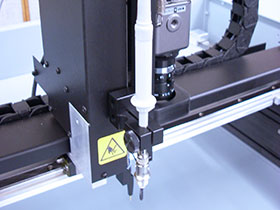
Access 2 Prober with Workstation SDK
-
Completely integrated Test System with low development time
-
Your measurements are integrated into Workstation
-
Most complete turn-key solution
-
Requires vendor instrument drivers (DLL)
-
Learn More >>
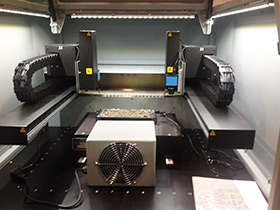
Access DH2 Prober with Hardware SDK
-
Design your Custom Test System using a proven robotic probing platform
-
Hardware SDK for creating custom applications
-
Tailor the application to your specific needs
-
DLLs and sample applications are supplied
-
Learn More >>
Flying Probe Technology - Automated Diagnostic Platforms
Huntron Access Probers have provided economical, automated single point (probe) diagnostics of densely packed surface-mount
circuit cards assemblies (CCA) since the early 1990's.
Surface mount technology has made the observation of constantly varying events a challenge when manual measurements are needed.
Huntron Access Probing Stations open the measurement spectrum to fixtureless diagnostic robotic probing.
Single or dual point systems provide accurate automation of one or two point measurements therefore reducing the manual
dexterity limits when an event needs to be captured.
Huntron Access Probing Stations can be configured to work with almost any standard measurement instrument such as
Huntron Trackers, multimeters, oscilloscopes, spectrum analyzers...
Integrated Systems Comparison Chart
|
Integration Level
|
Remote Control
|
Workstation SDK
|
Hardware SDK
|
|
Best Use
|
Adding Prober automation to other test instrumentation
|
Adding other test instrumention into Huntron Workstation
|
Integrating Huntron Products into other systems
|
|
Level of programming required
|
Minimal to Intermediate depending on existing software tools
|
Minimal due to single DLL modification
|
Extensive due to full application development
|
|
Supported programming languages
|
VS2010 VB.NET or any langauge/test executive that can call a .NET DLL
|
VS2010 VB.NET or any langauge that can create a .NET DLL
|
VS2010 VB.NET or any langauge that can call a .NET DLL
|
|
Hardware Supported
|
Huntron Trackers, Probers and other test instrumentation
|
Other test instrumentation
|
Huntron Probers and other test instrumentation
|
|
Huntron development services available?
|
Yes
|
Yes
|
Yes
|
|
Huntron Workstation needed?
|
Yes
|
Yes
|
No
|
|
Download Datasheet
|
Remote Control datasheet
|
Workstation SDK datasheet
|
Hardware SDK datasheet
|
Replace Board Test Fixtures
Testing methods for low-volume and prototype circuit boards are becoming harder with the increasing complexity and density.
Low-volume production runs or prototypes do not normally justify the cost of bed-of-nails in-circuit testing. The use of flying probe technology
provides a cost-effective solution.
Imagine the Possibilties
The ability to automate a test procedure will yield results not only in productivity but accuracy and repeatability.
What type of testing can be successfully automated? Read on...
-
Huntron Tracker Power-off
In repair situations it is often necessary to test the board without power applied due to uncertainty as to the nature of the failure.
-
Near Field RF Measurements
Eliminate manual sniffer probes methods by automating the placemnt of the RF probe with an Access Prober.
-
Point-to-point Component Measurements
Accurately measure voltage, resistance, current, capacitance, inductance and differential measurements between two points on a printed circuit assembly.
-
Stimulus / Response Measurements (Fault Injection)
Debug, fault injection, electrical transient monitoring and sustained engineering applications.
-
Boundary Scan
Use of the probes as independent cells to increase test coverage of interconnects and clusters of logic, memories etc.
-
Guided Probe Measurements
Physical contact, minimum impact on circuit operation, adequate signal fidelity, especially for high-density surface mount technology.
Passive, active, differential, logic and current probes can be mounted.
-
Multiple Probe Arrays
Add fixed probe arrays to access a number of points at one time. Maximum downforce is up to 5 lbs. (Access DH2)
-
More???
Custom integration of unique applications such as vision, infrared mapping, temperature sensing and mechanical manipulation.
General Specifications
Huntron currently manufactures three styles of Access Robotic Probers.
More detailed information is available on the
Access Probers web page.
-
Access 2 Prober
Larger single head prober well suited to larger PCAs.
-
Access DH2 Prober
Open architecture, two head prober suited for point-to-point testing as well as many other functions.


